

Global IV Bag Market to Hit USD 3.8 Billion by 2036 | India & China Lead Growth as Baxter, B. Braun Drive Innovation
IV Bag Market Size
US IV container sales to grow at 5.0% CAGR to 2036, driven by chronic disease care, premixed solutions, advanced therapies, and focus on safety and innovation.
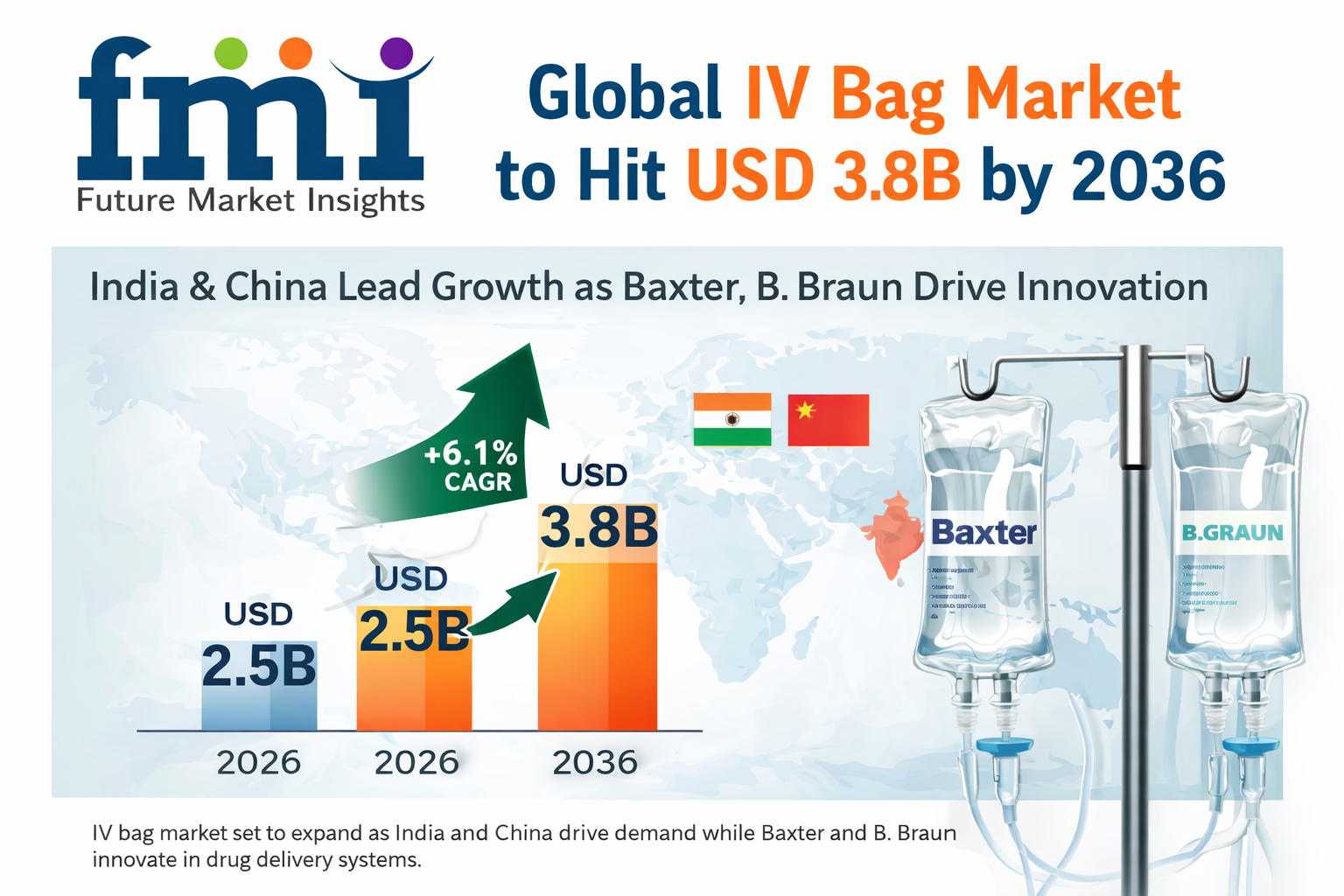
NEWARK , DE, UNITED STATES, March 27, 2026 /EINPresswire.com/ -- The IV Bag market is set to reach USD 2.5 billion in 2026 and grow at a 6.1% CAGR to exceed USD 3.8 billion by 2036, driven by rising chronic disease cases. Manufacturers are shifting to safer non-DEHP PVC and polyolefin films despite 15–20% higher costs to meet strict EU and US safety regulations.
As clinical safety standards tighten and chronic disease burden rises globally, procurement leaders are no longer buying just fluid containers they are investing in precision-engineered drug delivery systems.
According to the latest analysis by Future Market Insights (FMI), the global IV Bag Market is projected to grow from USD 2.5 billion in 2026 to USD 3.8 billion by 2036, expanding at a steady 6.1% CAGR. The shift is being driven by non-PVC materials, premixed drug adoption, and evolving hospital workflows.
Quick Stats: IV Bag Market at a Glance
• Market Value (2026): USD 2.5 Billion
• Forecast Value (2036): USD 3.8 Billion
• CAGR (2026–2036): 6.1%
• Leading Form: Single-chamber IV bags (58%)
• Top Application: Intravenous therapies (60%)
• Dominant Material: PVC (46%), with rapid non-PVC shift
• Key Growth Markets: India, China, United States
Get Access of Research Report Sample: https://www.futuremarketinsights.com/reports/sample/rep-gb-3580
The Strategic Shift: From Commodity Bags to Clinical Systems
The IV bag industry is undergoing a structural transformation. Traditional saline bags are increasingly being replaced by ready-to-administer (RTA) premixed drug formulations, reducing medication errors by ~30% in hospital environments.
This shift is not just clinical it is operational. Hospitals are increasingly streamlining pharmacy workflows to improve efficiency and reduce errors, while nurses benefit from plug-and-play infusion systems that simplify administration and save time. At the same time, manufacturers are advancing product innovation by developing multi-chamber bags using RF welding technologies, enabling safer and more convenient drug delivery solutions.
For decision-makers, this means procurement is moving upstream, favoring suppliers who can deliver integrated drug delivery compatibility not just packaging.
Why Non-PVC Materials Are Reshaping Manufacturing Economics
One of the most defining trends is the transition from traditional PVC to polyolefin-based materials (PP/PE).
While these advanced materials come at a 15–20% higher cost, they are rapidly becoming essential due to:
• EU MDR and US FDA compliance on plasticizers (DEHP)
• Reduced risk of drug interaction and leaching
• Improved environmental and incineration safety
However, this transition is capital-intensive:
• RF welding systems are ineffective for non-polar materials
• Manufacturers must adopt thermal or laser welding technologies
• Production lines require significant retrofitting
For legacy players, this represents a critical inflection point between compliance and competitiveness.
Production Bottlenecks: The Hidden Cost of Innovation
The rise of premixed and multi-chamber IV bags introduces new operational complexities:
Heat-sensitive formulations cannot undergo standard autoclaving at 121°C, creating significant challenges in sterilization. As a result, manufacturers must invest in advanced aseptic filling systems to maintain product safety and integrity. However, these requirements lead to longer production cycle times, ultimately impacting overall manufacturing throughput and operational efficiency.
At the same time, inventory turnover becomes crucial, especially for drug-filled bags with shorter shelf life. Efficient supply chains now directly impact profitability and hospital reliability.
Margin Pressure vs. Premium Innovation
IV bag manufacturers typically operate within 35%–45% gross margins, but face volatility due to petrochemical price fluctuations.
To offset this:
Companies are increasingly moving toward vertical integration, spanning from film extrusion to final filling, to gain greater control over quality, costs, and supply continuity. This strategic shift also supports premium pricing, which is driven by advancements in non-PVC innovations, growing investment in recycling initiatives, and the rising demand for high-value therapeutic applications.
Segment Insights: Where the Real Demand Lies
Single-Chamber Bags Continue to Dominate
• Hold 58% market share (2026)
• Essential for saline, dextrose, and emergency care
• Benefit from low-cost, high-volume manufacturing
Intravenous Therapies Drive Revenue
These applications account for nearly 60% of total demand and are critical for essential treatments such as antibiotics, hydration therapy, and pain management. Together, these segments remain foundational to the market, ensuring a stable baseline demand even as innovation and advanced therapeutic solutions continue to accelerate.
Emerging Growth Frontiers
Home Healthcare & Ambulatory Care
Demand is rising for portable and durable IV bags as healthcare increasingly shifts toward more flexible care settings. This trend is further supported by the growth in self-administered therapies, allowing patients greater convenience and independence. Additionally, integration with smart infusion pumps is enhancing precision, monitoring, and overall treatment efficiency.
Sustainability in Medical Plastics
Hospitals are increasingly prioritizing recyclable and PVC-free materials as part of broader sustainability goals. This shift is supported by the rise of “Green OT” certifications, which encourage environmentally responsible practices in operating theaters. At the same time, there is growing adoption of incineration-safe polymers, helping healthcare facilities reduce environmental impact while maintaining safety and compliance standards.
Multi-Chamber & Premixed Innovations
These solutions enable improved drug stability and extended shelf life, helping maintain efficacy over longer periods. They also reduce the need for hospital compounding, minimizing the risk of errors and contamination, while supporting critical applications such as oncology treatments and parenteral nutrition.
Regional Outlook: Where Growth is Accelerating
• India (7.2% CAGR): Driven by expanding healthcare access and domestic manufacturing initiatives
• China (7.0% CAGR): Aging population and hospital modernization fueling demand
• United States (5.0% CAGR): Strong adoption of premixed drugs and safety-driven procurement
• Germany (4.6% CAGR): Sustainability regulations accelerating non-PVC adoption
• Japan (3.3% CAGR): Growth in home-based elderly care solutions
Asia-Pacific is emerging as the volume growth engine, while North America leads in high-value innovation.
Competitive Landscape: Integration Becomes the Moat
Leading players such as Baxter, B. Braun Medical, ICU Medical, Fresenius Kabi Group, Terumo Corporation, and Poly Medicure are increasingly focused on:
• Vertical integration across the value chain
• Proprietary film technologies for drug compatibility
• Strategic collaborations with pharmaceutical companies
• Expansion of premixed drug portfolios
Notably, Baxter holds approximately 14% market share, leveraging its diversified healthcare portfolio.
What This Means for Decision Makers
The IV bag market is no longer a low-involvement procurement category. It sits at the intersection of:
• Patient safety
• Regulatory compliance
• Operational efficiency
• Sustainability goals
Organizations that align procurement strategies with non-PVC adoption, premixed drug systems, and supply chain resilience will be better positioned to reduce risks while improving clinical outcomes.
Frequently Asked Questions
1. What is the current size of the IV Bag Market?
The IV Bag Market is estimated to be valued at USD 2.5 billion in 2026, supported by rising demand for intravenous therapies, hydration solutions, and parenteral nutrition across global healthcare systems.
2. What is the projected value of the IV Bag Market by 2036?
The IV Bag Market is projected to reach USD 3.8 billion by 2036, expanding steadily due to increasing hospital admissions, chronic disease prevalence, and adoption of advanced IV delivery systems.
3. What is the expected growth rate of the IV Bag Market?
The IV Bag Market is expected to grow at a CAGR of 6.1% between 2026 and 2036, driven by innovation in non-PVC materials, premixed drug formulations, and healthcare infrastructure expansion.
Why FMI: https://www.futuremarketinsights.com/why-fmi
Explore More Research Reports by FMI:
PET Preform Market : https://www.futuremarketinsights.com/reports/pet-preforms-market
Barrier Tube Packaging Market : https://www.futuremarketinsights.com/reports/barrier-tube-packaging-market
MENA Industrial Packaging Market : https://www.futuremarketinsights.com/reports/mena-industrial-packaging-market
About Future Market Insights (FMI)
Future Market Insights (FMI) is a globally recognized market research and consulting firm, delivering data-driven insights across industries. With a strong focus on actionable intelligence, FMI supports organizations in navigating complex market transitions and identifying growth opportunities.
Sudip Saha
Future Market Insights Inc.
+1 347-918-3531
rahul.singh@futuremarketinsights.com
Legal Disclaimer:
EIN Presswire provides this news content "as is" without warranty of any kind. We do not accept any responsibility or liability for the accuracy, content, images, videos, licenses, completeness, legality, or reliability of the information contained in this article. If you have any complaints or copyright issues related to this article, kindly contact the author above.
