

Robotic Vacuum Cleaners Market to Hit USD 39.9 Billion by 2036 at 12.3% CAGR Fueled by AI-Driven Smart Home Adoption
Robotic Vacuum Cleaners Market
AI navigation, self-emptying docks, and smart home integration drive robotic vacuum cleaners market growth to USD 39.9 billion by 2036.
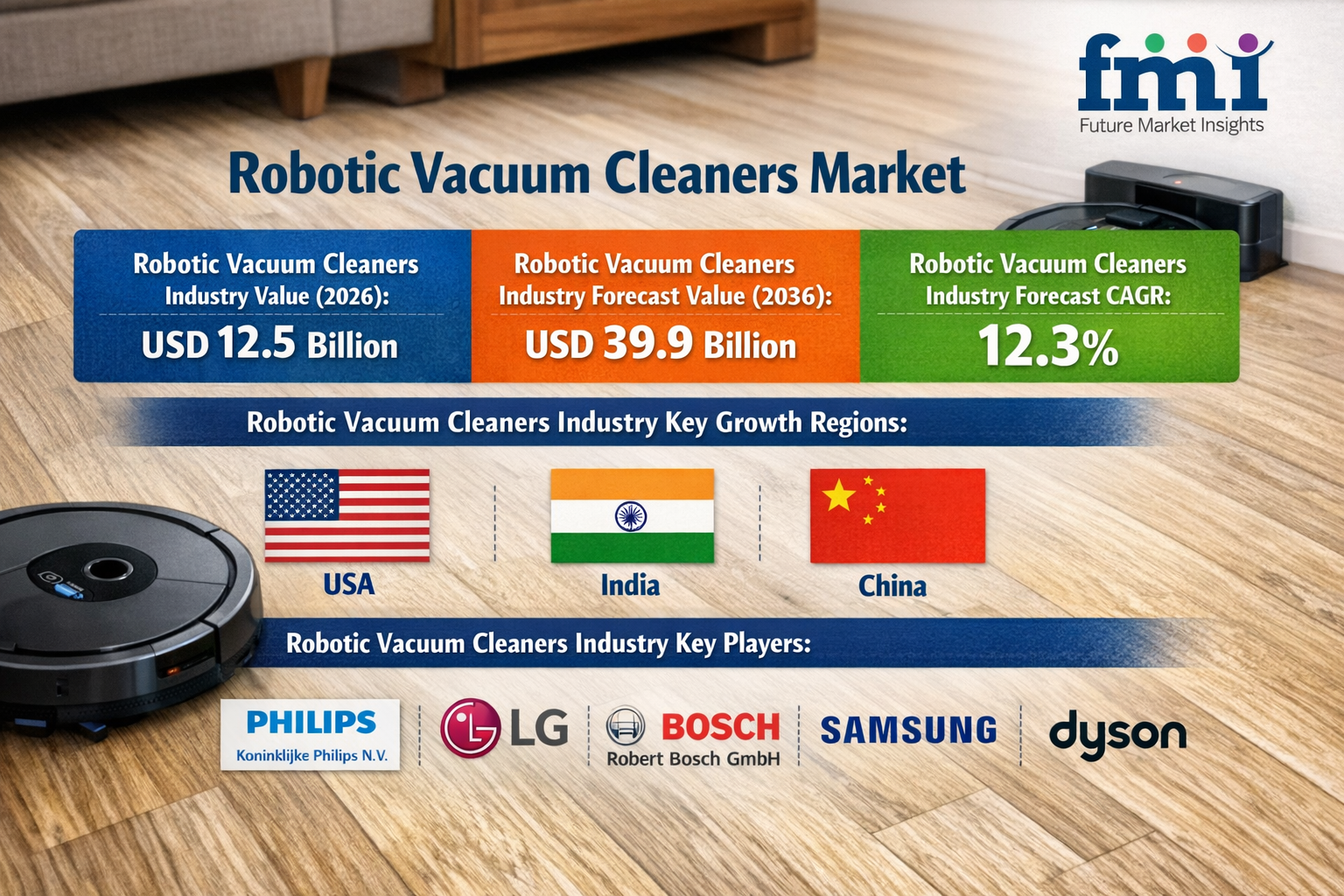
NEWARK, DE, UNITED STATES, February 23, 2026 /EINPresswire.com/ -- The global robotic vacuum cleaners market is projected to witness robust expansion over the next decade, increasing from USD 12.5 billion in 2026 to USD 39.9 billion by 2036, registering an impressive CAGR of 12.3%. According to the latest analysis by Future Market Insights (FMI), growth is fueled by advancements in autonomous navigation technologies, AI-driven object recognition, and the mainstream adoption of smart home ecosystems.
Manufacturers are transitioning from random navigation systems to LiDAR and vSLAM (visual Simultaneous Localization and Mapping) technologies, reducing cleaning time by nearly 30% per cycle. Premium models now offer suction power between 5,000 Pa and 8,000 Pa—significantly higher than the 2,000 Pa average of earlier generations. The market is also shifting toward fully “hands-free” maintenance, with self-emptying docks and mop-washing stations becoming standard features rather than optional upgrades.
Robotic Vacuum Cleaners Market Snapshot (2026–2036)
• Market size in 2026: USD 12.5 billion
• Market size in 2036: USD 39.9 billion
• CAGR (2026–2036): 12.3%
• Leading robot type: In-House robots (78% share)
• Leading sales channel: Online retailers (42% share)
• Leading functionality: Manual charging (51.0% share)
• Key growth regions: North America, East Asia, South Asia
• Fastest-growing countries: U.S., India, China, Japan, Germany
Request For Sample Report | Customize Report |purchase Full Report - https://www.futuremarketinsights.com/reports/sample/rep-gb-11949
Why the Market Is Growing
Demand is rising as consumers prioritize time-saving automation, particularly among dual-income households and pet owners. Enhanced wet-and-dry vacuum capabilities now mimic manual scrubbing performance, eliminating historical mopping limitations. Integration with voice assistants and smart home systems ensures seamless operation without physical interaction.
AI-powered object avoidance—supported by RGB cameras and Neural Processing Units (NPUs)—improves navigation around cables, socks, and pet waste. Although camera integration raises bill of materials (BOM) costs by 15–20% compared to LiDAR-only models, manufacturers offset this through reduced return rates and higher consumer satisfaction.
Privacy has also emerged as a critical adoption factor. Manufacturers are investing in edge-computing solutions that process mapping data locally rather than in the cloud, aligning with security standards such as ETSI EN 303 645, particularly for European and North American markets.
Battery sourcing remains a strategic challenge, as the automotive EV sector absorbs large volumes of lithium-ion supply. Companies are diversifying into Lithium Iron Phosphate (LFP) chemistries and securing long-term tier-2 supplier contracts to stabilize unit economics.
Segment Spotlight
Robot Type: In-House Robots Lead with 78% Share
Residential in-house robots dominate due to universal floor maintenance needs across apartments and suburban homes. Continuous improvements in slim-profile designs and under-furniture navigation reinforce segment leadership.
Sales Channel: Online Retailers Capture 42% Share
Online platforms remain the primary revenue stream, reflecting the tech-savvy consumer base. Video demonstrations, detailed specification comparisons, and drop-ship logistics models enhance digital purchasing confidence.
Charging Mode: Manual Charging Maintains 51% Share
While auto-docking stations are gaining traction, manual charging units remain prevalent due to affordability in entry-level and mid-range categories.
Regional Growth: North America and Asia Drive Expansion
North America advances through premium model adoption and strong pet ownership trends, while East and South Asia benefit from rapid urbanization and smart home penetration.
• United States: 11.0% CAGR, supported by carpet-heavy households and self-emptying model adoption
• India: 10.0% CAGR, driven by smart city initiatives and growing disposable incomes
• China: 9.0% CAGR, supported by domestic tech giants and AI-driven manufacturing
• Japan: 9.0% CAGR, fueled by aging demographics and demand for quiet, compact devices
• Germany: 8.5% CAGR, anchored in engineering quality and GDPR-compliant data processing
Drivers, Opportunities, Trends, Challenges
Drivers: Urban automation demand, AI-driven navigation, smart home integration
Opportunities: Robot-as-a-Service models, consumable ecosystem monetization, multifunctional docking stations
Trends: Edge AI computing, semantic mapping, self-cleaning mop systems, sustainable packaging
Challenges: Lithium-ion battery volatility, rising customer acquisition costs (CAC), data privacy compliance
Competitive Landscape
The market remains highly competitive, with players focusing on AI differentiation, software ecosystems, and sustainability-led product design.
Leading manufacturers include:
• Koninklijke Philips N.V.
• LG Electronics
• Robert Bosch GmbH
• Samsung Electronics
• Dyson Ltd.
• iRobot Corporation
• Panasonic Corporation
• Xiaomi Corporation
• ECOVACS Robotics
• Proscenic
Market leaders are investing heavily in proprietary “cleaning OS” platforms, semantic mapping, and predictive maintenance algorithms to maintain differentiation. Sustainability initiatives—such as modular repairable designs and eco-friendly packaging—are emerging as competitive priorities.
Frequently Asked Questions (FAQs)
1. How large is the robotic vacuum cleaners market in 2026?
The market is estimated to be valued at USD 12.5 billion in 2026.
2. What will be the market size by 2036?
It is projected to reach USD 39.9 billion by 2036.
3. What is the expected CAGR from 2026 to 2036?
The market is expected to grow at a CAGR of 12.3%.
4. Which robot type leads the market in 2026?
In-House robotic vacuum cleaners lead with a 78% market share.
5. Which sales channel dominates the market?
Online retailers account for the largest share at 42% in 2026.
Why FMI: https://www.futuremarketinsights.com/why-fmi
Browse Related Insights
2-in-1 Wet and Dry Vacuum Cleaners Market : https://www.futuremarketinsights.com/reports/2-in-1-wet-and-dry-vacuum-cleaners-market
Smart Mite Removal Vacuum Cleaner Market: https://www.futuremarketinsights.com/reports/smart-mite-removal-vacuum-cleaner-market
Custom T-Shirt Printing Market: https://www.futuremarketinsights.com/reports/custom-t-shirt-printing-market
About Future Market Insights (FMI)
Future Market Insights, Inc. (FMI) is an ESOMAR-certified, ISO 9001:2015 market research and consulting organization, trusted by Fortune 500 clients and global enterprises. With operations in the U.S., UK, India, and Dubai, FMI provides data-backed insights and strategic intelligence across 30+ industries and 1200 markets worldwide.
Sudip Saha
Future Market Insights Inc.
+1 347-918-3531
email us here
Legal Disclaimer:
EIN Presswire provides this news content "as is" without warranty of any kind. We do not accept any responsibility or liability for the accuracy, content, images, videos, licenses, completeness, legality, or reliability of the information contained in this article. If you have any complaints or copyright issues related to this article, kindly contact the author above.
